
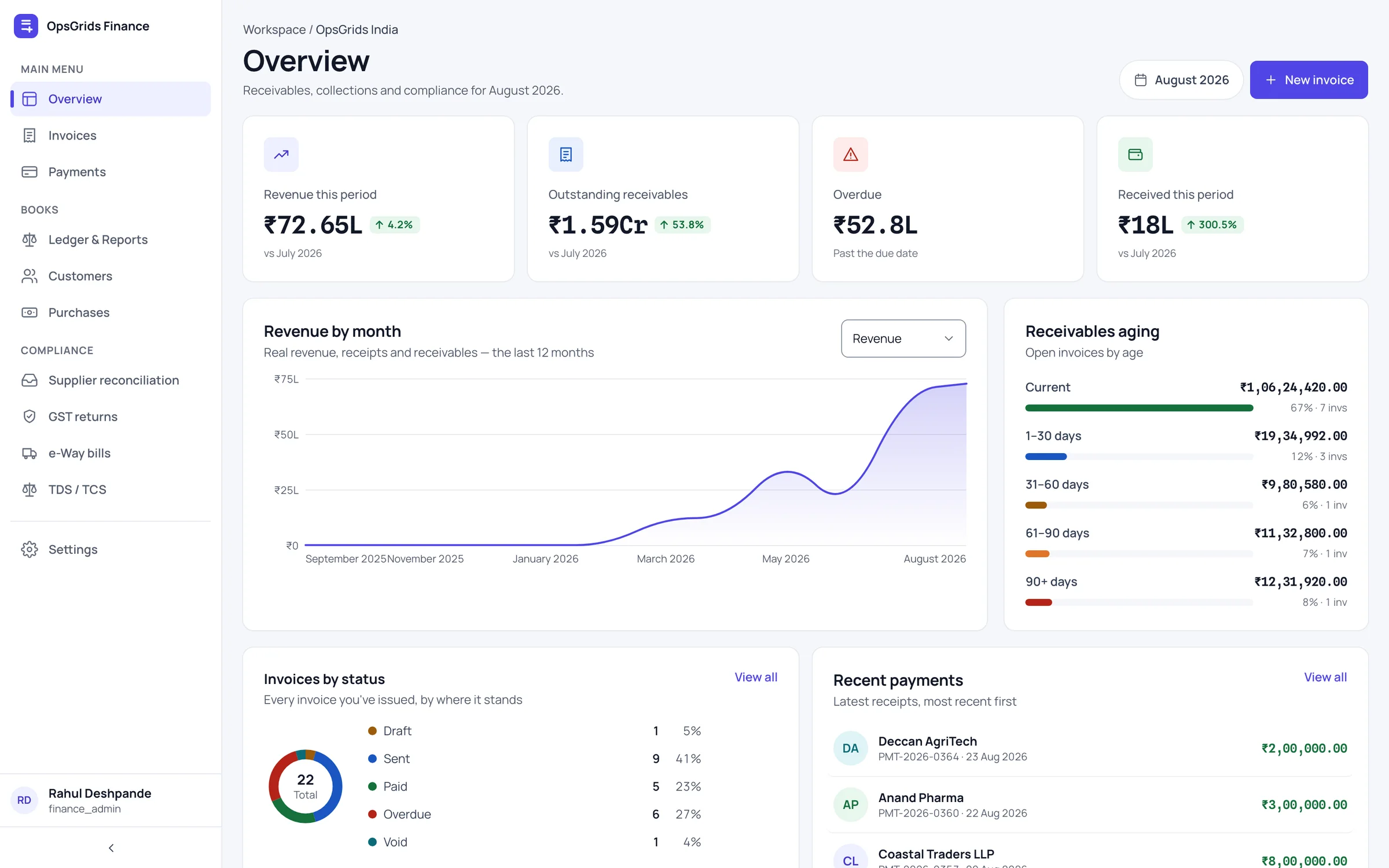
OpsGrids Finance keeps invoices, payments, GST and TDS on one ledger, so the person who raises an invoice and the person who reconciles GST work from the same record. It suits Indian B2B businesses that have outgrown spreadsheets, where one invoice gets keyed into several tools and returns get checked against the books by hand.
Who it is for
- An owner or finance head whose billing, GST work and payments live in three different files.
- A billing team preparing for e-invoicing that wants each IRN kept on its invoice once the portal link is live.
- A GST lead who reconciles supplier invoices monthly and wants the purchase book open while doing it.
- An accounts payable team that wants TDS recorded on the vendor payment itself.
- A controller or CA who wants corrections to appear as new entries, not overwritten cells.
What you can do with it
Invoices, payments and allocations
Raise invoices, record incoming payments and allocate each one against the invoice it settles, so a part-payment lands on the right invoice. When an invoice is finalised, a notification rule can send that event to the customer's billing contact on WhatsApp or email, with a delivery receipt coming back. WhatsApp needs your organisation's WhatsApp Business account to be connected through Meta first.
GST registration, returns and the return diff
GST registrations and returns sit next to the transactions behind them. The return diff compares what you filed with your books, so a gap between books and return shows up as a difference, not months later in a manual tick-through.
E-invoicing (IRN): e-invoice-ready
The e-invoicing workflow is built: a B2B invoice keeps its IRN with it, and because invoices are append-only, the invoice behind an IRN is not quietly edited afterwards. Today the workflow runs against a simulated government portal, so it does not yet report invoices to the Invoice Registration Portal (IRP) or return a real IRN. The live connection is coming soon; until then, generate IRNs on the e-invoice portal or through your GST Suvidha Provider.
E-way bills
E-way bills live alongside the invoices they relate to, so billing and dispatch look at one record rather than passing invoice numbers around on chat. Like e-invoicing, this runs against a simulated portal today; raise live e-way bills on the e-way bill portal until the connection ships.
IMS supplier reconciliation
Finance reconciles supplier records against its own purchase book. The GST lead decides what to accept, reject or keep pending in the Invoice Management System with the books in front of them. The IMS workflow also runs against a simulated portal today, so supplier records are not yet pulled from the GST portal and IMS actions still have to be taken on the portal itself.
TDS withholding
Withhold TDS when you pay a vendor, so the deduction is recorded on the payment rather than in a separate tracker. Section and rate decisions stay with your tax team.
The full ledger
Everything posts to one ledger. Invoices are append-only: a correction is a new row and the original stays as it was. Money is held in whole minor units (paise) with a currency, so amounts do not drift through rounding.
How it fits a working week
- Daily: billing finalises invoices before goods move. Once the portal link is live, the IRN and e-way bill come from the same record; until then they are raised on the government portals.
- As money arrives: each payment is recorded and allocated to its invoice.
- When vendors are paid: TDS is withheld on the payment.
- Mid-month: once the draft GSTR-2B is out, the GST lead works through supplier records against the purchase book and takes IMS decisions.
- Around filing: the return diff shows where return and books disagree.
- When something is wrong: the fix goes in as a new row, never an edit.
GST and TDS inside the workflow
E-invoicing. The IRN is a 64-character SHA-256 hash of the supplier GSTIN, document type, document number and financial year. Under a GSTN advisory of 5 November 2024, from 1 April 2025 taxpayers with aggregate annual turnover of ₹10 crore and above cannot report an e-invoice older than 30 days. E-invoicing generally applies above ₹5 crore of aggregate turnover (Notification 10/2023-Central Tax); confirm with your CA. See the e-invoicing and IRN guide.
E-way bills. Generally needed above ₹50,000 of consignment value, and valid one day per 200 km for regular cargo. Confirm current limits with your CA.
IMS and returns. An accepted record makes ITC available and auto-populates GSTR-3B; a rejected one does not; a pending one stays out of GSTR-2B and GSTR-3B until actioned; no action means deemed accepted when GSTR-2B is generated. The draft appears on the 14th, which is why step 4 comes before filing. See GSTR-2B reconciliation with IMS and the daily GST workflow.
TDS. The Income-tax Act, 2025 replaced the 1961 Act on 1 April 2026. TDS sits in sections 392 and 393, with rates and thresholds retained, and the earlier of credit or payment decides which Act applies. Deposit is due by the 7th of the next month (30 April for March); late deposit attracts interest at 1.5% per month. More in the TDS guide.
Where it stops today
Finance is not connected to the government portals yet: e-invoicing, e-way bills and IMS run against a simulated portal, and online payment collection runs in test mode. Finance does not file returns and does not guarantee compliance; your data, the portals and your CA's judgement still decide the outcome. Matching a supplier invoice to a goods receipt is designed, not built: Finance reconciles against its own purchase book, while purchase orders and goods receipt live in Operations & Inventory. Approved timesheet hours becoming invoice lines is also designed, not built, so services teams still raise those lines themselves. See how B2B accounting workflows connect.
Questions buyers ask
Does Finance file my GST returns? No. It holds your returns and shows the diff between what you filed and your books; filing stays with you and your CA.
Can I generate an IRN from Finance? Not against the live portal yet. The e-invoicing workflow is built and runs against a simulated portal; the live IRP connection is coming soon. Until then, generate IRNs on the e-invoice portal or through your GST Suvidha Provider.
What happens when a finalised invoice is wrong? The correction is a new row. The original stays unchanged.
Does it match supplier invoices to goods receipts? Not yet. That is designed but not built; Finance reconciles against its own purchase book today.
Can customers be told when an invoice is final? Yes. A notification rule can send the invoice-finalised event to their billing contact by email, or on WhatsApp once your WhatsApp Business account is connected through Meta.
Sources (checked 5 October 2026)
- GSTN advisory, 5 November 2024, and IRN specification (einvoice.gst.gov.in)
- Notification 10/2023-Central Tax (gstcouncil.gov.in)
- GSTN Invoice Management System FAQs (tutorial.gst.gov.in)
- E-way bill portal (ewaybillgst.gov.in), where current limits should be confirmed; the e-way bill figures above come from secondary reports
- Income Tax Department FAQs (incometax.gov.in)
- PIB (pib.gov.in)