
What each product does today, and where it stops.
Every product with its gaps flagged up front, so nothing surprises you in week three.
The products
What’s built, and what isn’t yet
BUILT AND RUNNING
Invoices, payments and allocations against them. GST registration, returns and the return diff. TDS withholding, and a full ledger underneath. The e-invoicing (IRN), e-way bill and IMS supplier reconciliation workflows are built and e-invoice-ready, and run against a simulated government portal today.
NOT YET
Not connected to the government portals yet: IRN generation, e-way bills and IMS run against a simulated portal, so nothing is reported to the IRP, the e-way bill system or the GST portal. Online payment collection runs in test mode.
What’s built, and what isn’t yet
BUILT AND RUNNING
Employee records with lifecycle transitions, reporting lines, and PII encrypted with an audited unmask. Check-in and check-out, shifts, PostGIS geo-fences, and attendance regularisation with the approval chain behind it.
NOT YET
No leave ledger. No payroll. If you need salary processing this quarter, this is not it yet.
What’s built, and what isn’t yet
BUILT AND RUNNING
Tickets with replies and assignment, an agent roster and SLA policies the overview measures against. On the IT side: incidents with worklogs, service requests, a service catalogue and an asset register.
NOT YET
Nothing outstanding to declare.
What’s built, and what isn’t yet
BUILT AND RUNNING
Inventory items carrying reorder points, warehouses, and suppliers scored on lead time, on-time percentage and spend. Purchase orders down to the line, and goods receipt against them.
NOT YET
Automation rules are absent. Reorder points are recorded and shown; nothing fires a purchase order on its own yet. Receiving and warehouses are in the API; their screens are still marked coming soon in the app.
What’s built, and what isn’t yet
BUILT AND RUNNING
Store identity and a deliberate publish step. Delivery zones drawn in postal codes, bulk import with conflicts shown before anything is written, a tester that answers through the same endpoint a buyer hits, and the demand report of areas turned away.
NOT YET
The theme gallery and page builder are a working preview: nothing a merchant designs is saved yet. No cart, checkout or orders. Fees and minimum order are shown, not charged. Custom domains designed, not live.
What’s built, and what isn’t yet
BUILT AND RUNNING
Leads you add by hand or import from Excel, converted in one step into a company, a contact and a deal. A deal pipeline with six fixed stages, shown as a board or a list. Companies and contacts with owners, a logged activity history, Excel import and export, and an audited reveal of sealed phone numbers and lead emails that needs a one-time code. Messaging-target resolution reaches a customer without decrypting their number.
NOT YET
No quotes: the quotation service is an empty scaffold. Pipeline stages are the same six for everyone and cannot be edited yet. No dated follow-up tasks: activities record what already happened. No web-form lead capture and no combined customer screen. In an organisation without HRMS, permissions limited to a rep's own records do not work yet.
What’s built, and what isn’t yet
BUILT AND RUNNING
Projects, milestones and tasks, with both a board and a timeline view over the same work.
NOT YET
Nothing outstanding to declare.
What’s built, and what isn’t yet
BUILT AND RUNNING
Projects and tasks against a people roster, timesheets, and daily standups: the shape an agency or a consulting team runs a week on.
NOT YET
Nothing outstanding to declare.
What’s built, and what isn’t yet
BUILT AND RUNNING
Campaigns and their performance, audiences, channels, and a revenue-versus-spend view per campaign.
NOT YET
Attribution does not yet read from the storefront: revenue is a figure the merchant enters, not one the store reports. There is no send path; messaging runs through Notification.
A scaffold means the service, its schema and its permissions exist and are deployed, but the feature on top is not written.
Stock and purchasing, on whichever screen is nearest.
Inventory items with reorder points, suppliers, and purchase orders down to the line.
Automation rules absent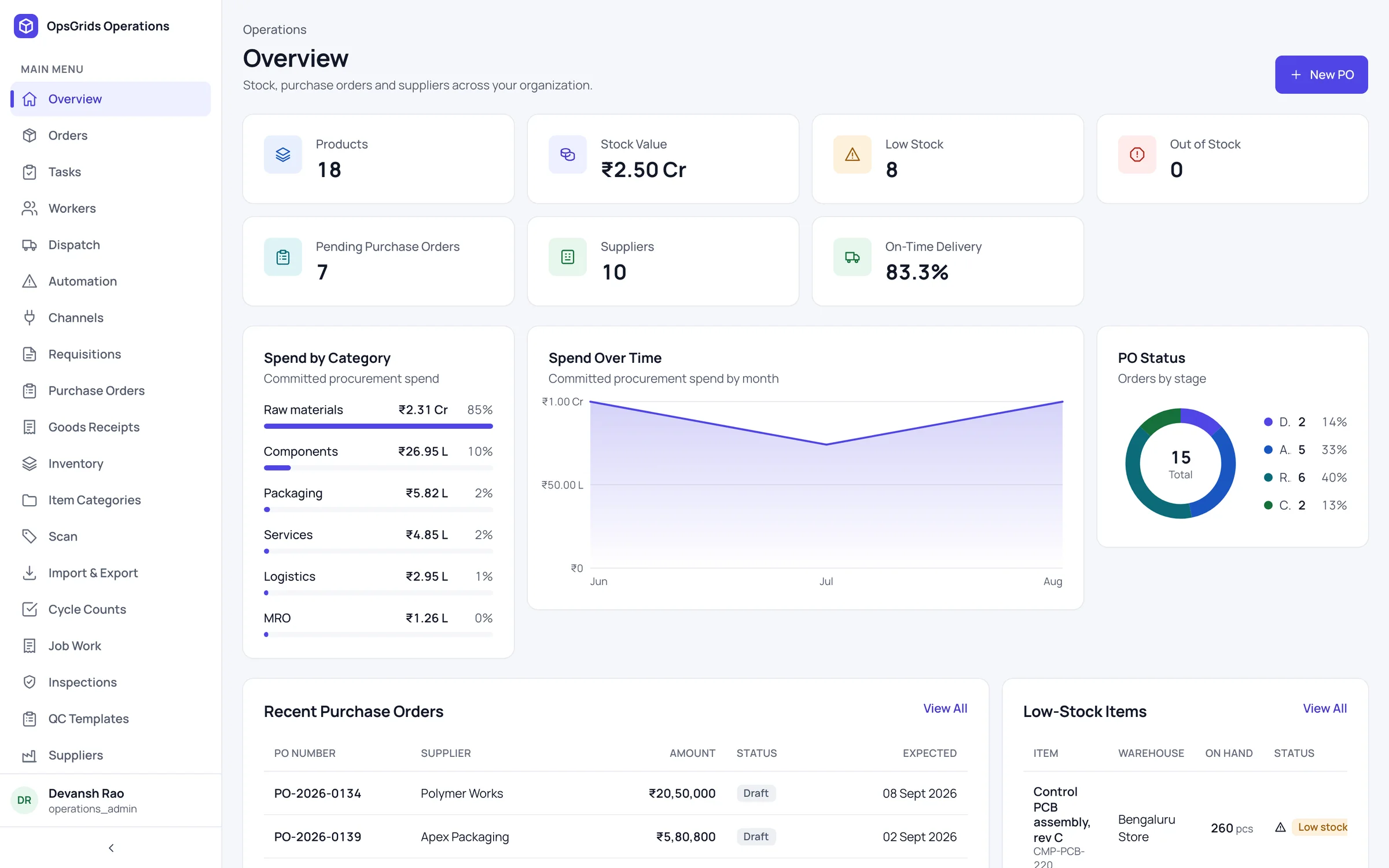
What two products give you that two vendors cannot
Products share one organisation, one directory and one audit trail. Two connections are live today.
- LIVE · HRMS + APPROVALS
An attendance correction routes up the employee's reporting line, escalates to the manager's manager when it sits unanswered, and applies to the record the moment it is approved. This is the one approval chain running end to end today.
- LIVE · CRM + NOTIFICATION
A contact's sealed phone number can be messaged without anyone decrypting it. The send resolves the target through the audited path, and the number never leaves the vault.
Designed, not built yet (4)
- HRMS + OPERATIONSDESIGNED, NOT BUILT
- A purchase order above a threshold would route up the same reporting line as an attendance correction. Today a PO's status is a local field; connecting it is a new approval request type and one consumer.
- OPERATIONS + FINANCEDESIGNED, NOT BUILT
- A goods receipt should be what the supplier invoice reconciles to. Today finance reconciles against its own purchase book; the receipt event is published and nothing yet consumes it.
- PULSEBOARD + FINANCEDESIGNED, NOT BUILT
- Approved timesheet hours should become an invoice line without re-keying. Today the invoice line has no source reference; the join is an event on approval plus one column.
- MARKETING + STOREFRONTDESIGNED, NOT BUILT
- Attribution should reach the store's own orders. There are no orders yet, so revenue-versus-spend is a figure the merchant enters, not one the store reports.
Not sure which one to start with?
Describe the part of the week that goes wrong most often. We will tell you which product touches it, or that none of them does yet.